

By Dr. María Priego, MD — Medical Doctor & Certified Infant Sleep Consultant (Medical Licence 0607196) · Founder of Baby Sleep And Smile, Dubai & Abu Dhabi
The short answer
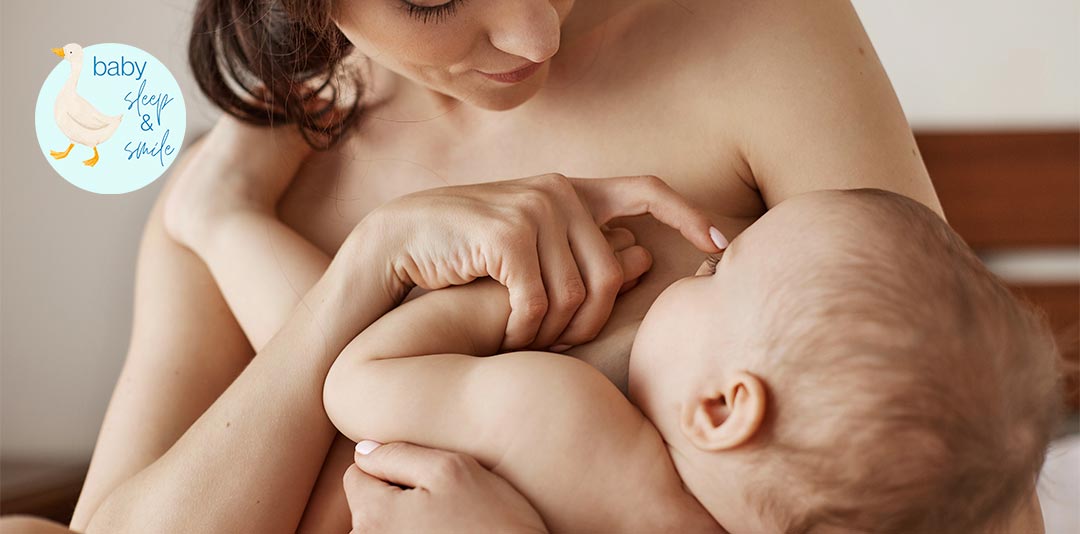
Yes, you can sleep train while breastfeeding. Sleeping and feeding are two separate skills, and your baby can learn to fall asleep independently while you continue to nurse — day and night — for as long as you both want. The key is a gentle, gradual approach that protects your milk supply and respects your baby’s need for closeness.
First, an honest note on the debate
You may have read that breastfeeding organisations advise caution. That’s true, and it’s worth understanding.
The Academy of Breastfeeding Medicine (ABM) and groups like La Leche League discourage rigid, cry-it-out style training in the first year, because early sleep is closely linked to feeding, milk supply and a baby’s sense of safety.
I share that caution — and it’s exactly why my approach is different. There is a wide space between “leave your baby to cry” and “do nothing at all.” Gentle, responsive methods live in that space. As a medical doctor, my job is to help you find better nights without asking you to choose between your baby’s wellbeing and your own rest.
Will sleep training reduce my milk supply?
It doesn’t have to. Milk supply responds to how often and how effectively milk is removed — not to where or how your baby falls asleep.
Supply problems usually appear when night feeds are dropped too quickly and all at once. The safeguard is simple:
- Keep the feeds your baby still needs. Younger babies genuinely need night feeds.
- Reduce them gradually, never overnight.
- Watch your body’s signals (fullness, comfort) and your baby’s nappies and weight.
If you’re prone to blocked ducts or have a history of low supply, we go slower and monitor more closely. This is where a medical perspective matters.
When is the best time to sleep train a breastfed baby?
Most babies are developmentally ready for gentle sleep shaping from around 4 to 6 months, once night feeds are less frequent and weight gain is well established. Before that, we focus on healthy foundations, not training.
There is no single “right” age — a breastfed baby can begin gentle work later without any problem. Readiness depends on your baby, not the calendar.
How do I separate feeding from falling asleep?
The goal isn’t to stop feeding your baby to sleep forever — it’s to give your baby another way to settle, so a feed isn’t the only route back to sleep.
A gentle sequence looks like this:
- Move the feed earlier in the bedtime routine, not as the very last step.
- Add a consistent wind-down after the feed: dim lights, a short story, cuddles.
- Put your baby down calm but awake, and support them with your presence.
- Respond to genuine hunger — you are not withholding food, you are changing the order of events.
This protects your nursing relationship while teaching independent sleep.
What about popular “rules” like 3-3-3 or 30-30-30?
Parents in Dubai ask me about these constantly. Here’s what they actually mean — and where they fall short.
| “Rule” | What it usually refers to | My honest take |
|---|---|---|
| 3-3-3 / 5-3-3 | Rough guides to wake windows and nap structure by age | Useful as a starting point, not a law. Every baby differs. |
| 30-30-30 | A feed/settle spacing idea (e.g. finish the feed ~30 min before sleep) | The principle — feed, then a gap, then sleep — is sound. The exact number isn’t magic. |
Rules give tired parents something to hold onto, and that’s understandable. But a breastfed baby who travels, teethes or hits a regression won’t read the rulebook. A plan built around your baby beats any formula.
Can a breastfed baby sleep through the night?
Yes — many do, and breastfeeding is not the obstacle it’s often blamed for. “Through the night” simply means your baby can link sleep cycles without needing help to resettle. Some babies keep one night feed for months and still sleep long, peaceful stretches around it. Both can be true at once.
Why families in Dubai and Abu Dhabi choose a doctor-led approach
Expat life here comes with its own sleep challenges: time-zone jumps on trips home, changing nannies, hot afternoons, and grandparents advising from three time zones away.
At Baby Sleep And Smile, you get something most sleep services can’t offer:
- A real medical doctor (not only a coaching certificate) reading your baby’s full picture — feeding, weight, health and sleep together.
- Gentle methods only. No cry-it-out, ever. Fully compatible with breastfeeding.
- Support in your language. We work in English and native Spanish — a genuine relief for Spanish-speaking families far from home at 3 a.m.
- 200+ UAE families already sleeping better.
Your next step: a free discovery call
If you’re breastfeeding and exhausted, you don’t have to choose between nursing and sleeping. Let’s build a gentle plan around your baby — and your family.
→ Book your free 15-minute discovery call
No pressure, no scripts. Just a doctor who understands both the medicine and the sleepless nights.